International System of Protection

International System of Protection

The resources on this Module highlight the many commonalities between the United Nations system of protection for freedom of expression, and the regional systems in Europe, Africa and the Americas. Readings focus on their birth and development, their main treaties and freedom of expression provisions, and their corresponding instruments of enforcement and accountability, primarily Courts.

10 items found, showing 41 - 10

United Nations

Author: UN Human Rights Council, Special Rapporteur on the Promotion and Protection of the Right to Freedom of Opinion and Expression (David Kaye)
Media Type Icon

“In this report, the Special Rapporteur addresses two linked questions: First, do the rights to privacy and freedom of opinion and expression protect secure online communication, specifically by encryption or anonymity? And second, assuming an affirmative answer, to what extent may governments, consistent with human rights law, impose restrictions on encryption and anonymity? The report seeks to answer these questions, review examples of State practice, and propose recommendations. Drawing from research on international and national norms and jurisprudence, and the input of States and civil society, the report concludes that encryption and anonymity enable individuals to exercise their rights to freedom of opinion and expression in the digital age and, as such, deserve strong protection.”

UN Human Rights Council, Special Rapporteur on the Promotion and Protection of the Right to Freedom of Opinion and Expression, David Kaye. Report on Encryption, Anonymity, and the Human Rights Framework. A/HRC/29/32. May 2015 (Reissued in January 2018).

Author: Irene Khan, UN Special Rapporteur on the promotion and protection of the right to freedom of opinion and expression
Media Type Icon

In this report, Irene Khan, UN Special Rapporteur on the promotion and protection of the right to freedom of opinion and expression, unpacks gendered disinformation - a phenomenon that, Khan argues, demands more clarity and research. The Special Rapporteur builds on her earlier reports on disinformation and gender inequality in freedom of expression, as well as her conversations with individuals who experienced online abuse and consultations with regional civil society representatives, governments, and companies. Defining and analyzing the concept of gendered disinformation, the Special Rapporteur turns to a feminist framework and applies an intersectional approach. The report stresses the “dual nature” of gendered disinformation, explaining it as “a strategy to silence women and gender-diverse voices” and noting it can be “a form of online gender-based violence in some situations.” Three more parts follow the phenomenon’s framing: “Survivors, harm, actors and vectors,” “Roles, responsibilities and responses: States,” and “Roles, responsibilities and responses: companies and civil society.” The report concludes with recommendations for states, social media companies, and other relevant actors.

UN, Human Rights Council, General Assembly, Special Rapporteur on the promotion and protection of the right to freedom of opinion and expression, Irene Khan. Report on Gendered Disinformation and Its Implications for the Right to Freedom of Expression. A/78/288. August 7, 2023. https://daccess-ods.un.org/access.nsf/Get?OpenAgent&DS=A/78/288&Lang=E


Author: United Nations, David Kaye
Media Type Icon

“In a world of rising calls for limits on hate speech, international human rights law provides standards to govern State and company approaches to online expression. In the present report, submitted in accordance with Human Rights Council resolution 34/18, the Special Rapporteur on the promotion and protection of the right to freedom of opinion and expression explains how those standards provide a framework for Governments considering regulatory options and companies determining how to respect human rights online. The Special Rapporteur begins with an introduction to the international legal framework, focusing on United Nations treaties and the leading interpretations of provisions related to what is colloquially called “hate speech”. He then highlights key State obligations and addresses how content moderation by companies may ensure respect for the human rights of users and the public. He concludes with recommendations for States and companies.”

UN, Special Rapporteur on the Promotion and Protection of the Right to Freedom of Opinion and Expression, David Kaye. Report on Online Hate Speech. A/74/486. October 2019.

Author: UN Human Rights Council, Special Rapporteur on the Promotion and Protection of the Right to Freedom of Opinion and Expression
Media Type Icon

“Surveillance of individuals – often journalists, activists, opposition figures, critics and others exercising their right to freedom of expression – has been shown to lead to arbitrary detention, sometimes to torture and possibly to extrajudicial killings. Such surveillance has thrived amid weak controls on exports and transfers of technology to Governments with well-known policies of repression. In the present report, the Special Rapporteur begins by identifying the problem of targeted surveillance seen from the obligations that human rights law imposes on States and the related responsibilities of companies. He then proposes a legal and policy framework for regulation, accountability and transparency within the private surveillance industry. He concludes with a call for tighter regulation of surveillance exports and restrictions on their use, as well as a call for an immediate moratorium on the global sale and transfer of the tools of the private surveillance industry until rigorous human rights safeguards are put in place to regulate such practices and guarantee that Governments and non-State actors use the tools in legitimate ways.”

UN Human Rights Council, Special Rapporteur on the Promotion and Protection of the Right to Freedom of Opinion and Expression. Report on the Adverse Effect of the Surveillance Industry on Freedom of Expression. A/HRC/41/35. May 2019.

Author: UN Human Rights Council, Special Rapporteur on the Promotion and Protection of the Right to Freedom of Opinion and Expression (David Kaye)
Media Type Icon

“Threats to digital expression and Internet freedom are more pronounced than ever. Internet shutdowns have emerged as a popular means of information control. Government surveillance continues to intensify worldwide, jeopardizing the privacy and security of millions. Net neutrality – the long-held premise that all Internet data should be treated equally and without undue interference – has come under attack. In this increasingly hostile environment, what are the human rights responsibilities of the Information, Communications and Technology sector – particularly those actors that facilitate the provision of telecommunications and Internet access, and serve as gatekeepers of the digital infrastructure? To address this question, the Special Rapporteur first examines the role of States in undermining freedom of expression online, and what their obligation to protect this fundamental right entails. The Special Rapporteur subsequently evaluates the role of digital access providers – not just telecommunications companies and Internet service providers, which have become synonymous with digital access, but also non-consumer facing actors like network equipment vendors, content delivery networks, and Internet exchange points. Drawing on the United Nations Guiding Principles on Business and Human Rights and best practices in the field, the Special Rapporteur proposes concrete steps that digital access providers should take to safeguard the freedom of expression of Internet users worldwide.”

UN Human Rights Council, Special Rapporteur on the Promotion and Protection of the Right to Freedom of Opinion and Expression. Report on the Role of Digital Access Providers. A/HRC/35/22. March 2017.

Author: United Nations General Assembly
Media Type Icon

The UN resolution acknowledges that some new and emerging technologies may not be compatible with international human rights law. Evidence shows that emotion recognition technologies are fundamentally incompatible with human rights, and future resolutions should ban these technologies. The resolution also introduces stronger language on remote biometric surveillance systems, such as facial recognition, which raises concerns about their proportionality. The increasing use of biometric technologies has chilling effects on freedom of expression and behaviour, deterring people from participating in public assemblies or expressing their ideas or religious beliefs. Governments are called to prohibit remote biometric identification in publicly accessible spaces and mass surveillance. However, the core group failed to address new challenges for privacy, such as social media monitoring. The resolution is urged to include strong recommendations to ensure social media intelligence collection, analysis, and sharing strictly conforms with human rights standards and data protection frameworks.

UN, Human Rights Council. Resolution 54/21. Right to privacy in the digital age. A/HRC/RES/54/21. 12 October 2023. https://documents-dds-ny.un.org/doc/UNDOC/GEN/G23/215/42/PDF/G2321542.pdf?OpenElement

Author: The United Nations Educational, Scientific and Cultural Organization
Media Type Icon

Culture and creativity are crucial economic sectors, accounting for 3.1% of GDP and 6.2% of employment. In 2019, exports of cultural goods and services doubled, reaching $389.1 billion. However, the creative economy faces challenges, including the pandemic, which led to over 10 million job losses. Public investment in culture has declined, and creative professions remain unstable and underregulated. Gender equality remains distant, and only 13% of voluntary national reviews acknowledge culture's contribution to sustainable development.

Disparities between developed and developing countries are significant, with developed countries leading the trade of cultural goods and services. The COVID-19 pandemic highlights the need for countries to protect and promote diversity within their territories and beyond. Culture's global public good must be preserved for the benefit of present and future generations.

This report "offers insightful new data that shed light on emerging trends at a global level, as well as puts forward policy recommendations to foster creative ecosystems that contribute to a sustainable world by 2030 and beyond". Also published is a new video on the importance of protecting artists and defending artistic freedom.

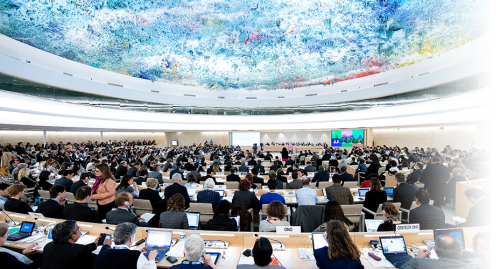
The United Nations Educational, Scientific and Cultural Organization. 'Re|shaping policies for creativity: addressing culture as a global public good'. 2022. https://unesdoc.unesco.org/ark:/48223/pf0000380474/PDF/380474eng.pdf.multi

Author: Special Rapporteur on the situation of human rights in the Russian Federation, Mariana Katzarova
Media Type Icon

In her latest report to the UN Human Rights Council, Mariana Katzarova, Special Rapporteur on the situation of human rights in the Russian Federation, described the Kremlin’s escalation of repressions as a deliberate strategy to eliminate dissent. The vague and overly broad laws – on “foreign agents,” “undesirable organizations,” “discrediting the armed forces,” “disseminating fake news” about the army, “terrorism,” and “extremism” – remain instrumental in facilitating politically motivated prosecutions. Impunity – for Russia’s aggression against Ukraine, widespread torture, and ill-treatment – persists. “Justice inside Russia is unattainable,” Katzarova stressed, calling on the international community to mobilize accountability frameworks, including universal jurisdiction.

Special Rapporteur on the situation of human rights in the Russian Federation, Mariana Katzarova. Situation of Human Rights in the Russian Federation, A/HRC/60/59 (advance edited version), September 2025. https://www.ohchr.org/sites/default/files/documents/hrbodies/hrcouncil/sessions-regular/session60/advance-version/a-hrc-60-59-aev.pdf

Author: United Nations High Commissioner for Human Rights with the International Bar Association
Media Type Icon

Chapter 12 of Human Rights in the Administration of Justice, a manual and facilitator’s guide developed by the UN OHCHR in collaboration with the IBA, pertains to the right to freedom of thought, conscience, religion, opinion, expression, association and assembly. The learning objectives of this chapter are: “1.) To familiarize the participants with some other key rights, namely freedom of thought, conscience, religion, opinion, expression, association and assembly, and their importance in a society that is respectful of human rights in general; 2.) To illustrate how these freedoms, as well as the limitations attached to the exercise of most of them, are interpreted by the international monitoring bodies; 3.) To explain the role of judges, prosecutors and lawyers in safeguarding the freedoms dealt with in this chapter.”

United Nations High Commissioner for Human Rights with the International Bar Association. “Some Other Key Rights: Freedom of Thought, Conscience, Religion, Opinion, Expression, Association and Assembly”. Ch. 12 in Human Rights in the Administration of Justice: A Manual on Human Rights for Judges, Prosecutors, and Lawyers 2003. https://www.ohchr.org/documents/publications/training9chapter12en.pdf.

Author: Justice for Journalists Foundation, OVD-Info, Access Now, Article 19
Media Type Icon

The authors have submitted a Joint UPR Submission that gauges the worsening situation of freedom of expression in Russia, for the 44th Session of the Working Group. The submission examines the persecution of media workers and media outlets; criminalisation of speech and assembly and association; the use of war propaganda and incitement of hatred and violence; the use of internet shutdowns; website blocking; the use of surveillance in violation of Russia’s obligations enshrined in the International Covenant on Civil and Political Rights.

Article 19 et al. 2023. 'Submission to the United Nations Human Rights Council on the Universal Periodic Review 44th Session Fourth Cycle for the Russian Federation'. https://www.article19.org/wp-content/uploads/2023/04/Russia_Joint-UPR-Submission_JFJ_OVD_A19_Access_Final-.pdf