
International System of Protection

International System of Protection

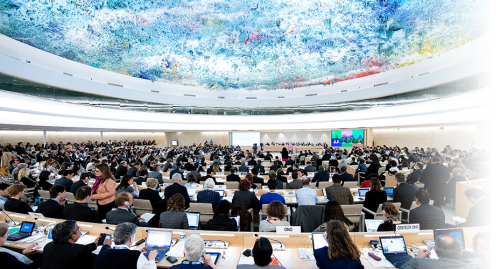
The resources on this Module highlight the many commonalities between the United Nations system of protection for freedom of expression, and the regional systems in Europe, Africa and the Americas. Readings focus on their birth and development, their main treaties and freedom of expression provisions, and their corresponding instruments of enforcement and accountability, primarily Courts.

10 items found, showing 31 - 10

European System

Author: Luca Belli and Nicolo Zingales (eds)
Media Type Icon

“This book is the Official 2017 Outcome of the UN IGF Dynamic Coalition on Platform Responsibility (DCPR), which is a multistakeholder group fostering a cooperative analysis of online platforms’ responsibility to respect human rights, while putting forward solutions to protect platform-users’ rights. This book offers responses to the DCPR’s call for multistakeholder dialogue, made ever more pressing by the diverse and raising challenges generated by the platformisation of our economy and, more generally, our society. The analyses featured in this book critically explore the human rights dimension of the digital platform debate, subsequently focusing on the governance of personal data and, lastly, suggesting new solutions for the new roles played by online platforms. This volume includes the Recommendations on Terms of Service and Human Rights, which were elaborated through a multistakeholder participatory process, facilitated by the DCPR. In accordance with the UN Guiding Principles on Business and Human Rights, the Recommendations provide guidance for terms of service that may deemed as “responsible” due to their respect of internationally agreed human rights standards.”  

Luca Belli and Nicolo Zingales (eds). “Platform Regulations: How Platforms are Regulated and How they Regulate Us”. 2017. http://bibliotecadigital.fgv.br/dspace/handle/10438/19402.


Author: Council of the European Union
Media Type Icon

In May 2023 the Council of the European Union issued this compromise text of a Directive of the European Parliament and Council to protect human rights defenders and journalists who engage in public participation from manifestly unfounded or abusive court proceedings, also known as strategic lawsuits against public participation or SLAPPs. The compromise text was issued based on a lengthy consultative process including input from the SLAPP Working Party and Member States. Overall, Member States support “the aim of the directive to eliminate obstacles to the proper functioning of civil proceedings, while providing protection for the right to freedom of expression and media freedom.” However, they also “stressed that the procedural safeguards provided in the directive should be carefully targeted and in line with the right to an effective remedy and to a fair trial, in order to eliminate the risk of abuses by those the directive aims to protect.” At the same time, the Directive should not prevent legitimate claims from benig heard. The compromise text must be approved by the relevant parties before it can form the “basis for the negotiations with the European Parliament in the framework of the ordinary legislative procedure (Art. 294 TFEU).”

Council of European Union. 2022/0117. Proposal for a Directive of the European Parliament and of the Council on protecting persons who engage in public participation from manifestly unfounded or abusive court proceedings. 9263/23. 17 May 2023. https://data.consilium.europa.eu/doc/document/ST-9263-2023-INIT/en/pdf

Author: European Commission
Media Type Icon

The Commission's proposal for the Regulation aims to safeguard media independence and promote media pluralism across the EU, in addition to establishing specific requirements for Very Large Online Platforms as defined under the Digital Services Act.

European Commission. 'Proposal for a REGULATION OF THE EUROPEAN PARLIAMENT AND OF THE COUNCIL establishing a common framework for media services in the internal market (European Media Freedom Act) and amending Directive 2010/13/EU'. 2022. https://eur-lex.europa.eu/legal-content/EN/TXT/?uri=CELEX%3A52022PC0457 

Author: Dominika Bychawska-Siniarska
Media Type Icon

This is a a handbook for legal practitioners on protecting the right to freedom of erxpression under the European Convention on Human Rights. The chapters  are: 1: General consideration on Article 10; 2: Duties under Article 10; 3 Unprotected speech-hate, speech, incitement to violence; 4: The system of restrictions within the exercise of the right to freedom of expression; 5: Limitations due to "public" reasons; 6: Freedom of expression and reputation; 7: Rights of others; 8: Freedom of expression and the media; 9: Freedom of expression and new technologies.

Dominika Bychawska-Siniarska Bychawska-Siniarska Protecting the Right to Freedom of Expression under the European Convention on Human Rights: a handbook for legal practitioners (Strasbourg, Council of Europe Publishing, 2017).

Author: ILGA-Europe
Media Type Icon

The International Lesbian, Gay, Bisexual, Trans, and Intersex Association (ILGA) in Europe published its annual flagship report “2025 Rainbow Map” – a snapshot of the state of human rights for LGBTQI+ communities on the continent. The sharpest drops that the report recorded concern Hungary, where the authorities banned a Pride parade, the UK, where the Supreme Court defined a woman by “biological sex,” and Georgia, where a broad anti-LGBTQI+ legislation package, mirroring Russia’s laws, was passed. Calling attention to the setbacks and overall erosion of democracy in Europe, the report also spotlights resistance through courts: the CJEU’s rulings that Hungary “must correct the gender markers of transgender refugees without requiring proof of surgery” and that “France’s gender-based railway ticketing system violated GDPR, discriminating against non-binary and transgender individuals,” as well as national courts’ decisions in Czechia, Lithuania, Slovenia, and Spain.

ILGA-Europe. 2025 Rainbow Map, ILGA-Europe, May 2025. https://rainbowmap.ilga-europe.org/
 

Author: Anya Schiffrin, Bojana Kostic, Iva Nenadic, Julia Haas, Natali Helberger, Max van Drunen
Media Type Icon

This policy manual, published by the Office of the OSCE Representative for Freedom of the Media, focuses on the erosion of media freedom in today’s digital information ecosystem dominated by social media platforms, search engines, and AI companies. Based on consultations with more than 150 prominent experts in the fields of the media, civil society, policy-making, and academia, the manual offers mitigation measures and recommendations to States in three broad areas: 1) visibility – promotion of independent and public interest journalism, with robust safeguards; 2) viability – “fair remuneration, including news media bargaining codes and digital levies”; and 3) vigilance – preventing online violence against journalists.

Anya Schiffrin, Bojana Kostic, Iva Nenadic, Julia Haas, Natali Helberger, Max van Drunen. Safeguarding Media Freedom in the Age of Big Tech Platforms and AI, Office of the Representative on Freedom of the Media Organization for Security and Co-operation in Europe, October 2025. https://www.osce.org/files/f/documents/e/3/598525_1.pdf

Author: United Nations High Commissioner for Human Rights with the International Bar Association
Media Type Icon

Chapter 12 of Human Rights in the Administration of Justice, a manual and facilitator’s guide developed by the UN OHCHR in collaboration with the IBA, pertains to the right to freedom of thought, conscience, religion, opinion, expression, association and assembly. The learning objectives of this chapter are: “1.) To familiarize the participants with some other key rights, namely freedom of thought, conscience, religion, opinion, expression, association and assembly, and their importance in a society that is respectful of human rights in general; 2.) To illustrate how these freedoms, as well as the limitations attached to the exercise of most of them, are interpreted by the international monitoring bodies; 3.) To explain the role of judges, prosecutors and lawyers in safeguarding the freedoms dealt with in this chapter.”

United Nations High Commissioner for Human Rights with the International Bar Association. “Some Other Key Rights: Freedom of Thought, Conscience, Religion, Opinion, Expression, Association and Assembly”. Ch. 12 in Human Rights in the Administration of Justice: A Manual on Human Rights for Judges, Prosecutors, and Lawyers 2003. https://www.ohchr.org/documents/publications/training9chapter12en.pdf.

Author: Columbia Global Freedom of Expression, Agnès Callamard
Media Type Icon

In this segment of the MOOC created by Columbia Global Freedom of Expression, Agnès Callamard focuses on the ECtHR Jurisprudence on Incitement

Author: Open Society European Policy Institute (Laurent Pech)
Media Type Icon

As Open Society Foundations summarizes this incisive and timely report, “This publication from the Open Society European Policy Institute, the Brussels-based policy and advocacy branch of the Open Society Foundations network, and authored by Professor Laurent Pech, examines whether it is possible to use the chilling effect to promote and protect democracy, rule of law, and fundamental rights. In its negative form, the chilling effect is used by some governments to create a climate of self-censorship that deters democratic actors such as journalists, advocates and judges from speaking out. To stop autocratic-minded authorities from achieving their goal of inspiring self-censorship among democratic actors, this report recommends systemically integrating the concept of chilling effect into the EU’s infringement framework of analysis. This will establish a foundation to better allow the EU to protect freedom of association, judicial independence, and media freedom.”

Open Society European Policy Institute (Laurent Pech). “The Concept of Chilling Effect: Its Untapped Potential to Better Protect Democracy, The Rule of Law, and Fundamental Rights in the EU”. 2021. https://www.opensocietyfoundations.org/uploads/c8c58ad3-fd6e-4b2d-99fa-d8864355b638/the-concept-of-chilling-effect-20210322.pdf.

Author: Columbia Global Freedom of Expression, Agnès Callamard
Media Type Icon

In this segment of the MOOC 'Freedom of Expression in the Age of Globalization' created by Columbia Global Freedom of Expression, Agnès Callamard starts looking at how the systems of protection for human rights and freedom of expression in particular have been established at regional level, beginning with Europe.